



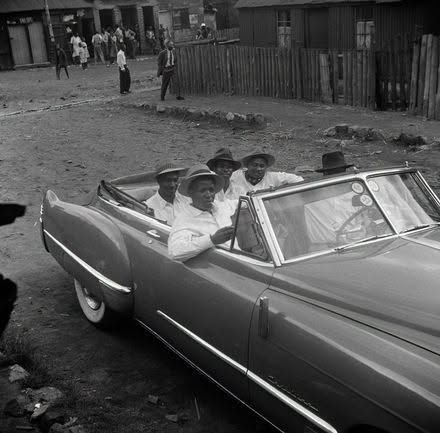
In the vibrant, defiant, and ultimately doomed suburb of Sophiatown, Johannesburg, 1954 was a year poised on the edge of a knife. The apartheid government was preparing the forced removals that would raze the neighborhood to the ground just a year later.
Amidst this cultural and political pressure cooker, The Americans reigned supreme. They weren’t just a gang; they were the absolute kings of style, bravado, and a highly localized, Hollywood-inspired social rebellion.
Who Were “The Americans”?
Originally starting as a tight-knit crew of brothers, cousins, and friends who pulled small-time pickpocketing jobs, The Americans quickly evolved into Sophiatown’s most formidable and flashy organized crime syndicate. They were led for a time by the legendary George “Kort Boy” Mpalweni, a pint-sized but incredibly fierce figure.
Unlike rival gangs (like The Berliners or The Gestapo, who terrorized locals), The Americans cultivated a Robin Hood-esque reputation:
- The Targets: They strictly robbed wealthy white-owned businesses, delivery trucks, and the Braamfontein railway yards.
- The “Spoils”: They sold high-quality stolen goods back to the township community at a fraction of the cost.
- The Community Rule: They prided themselves on “not messing around” with the local Sophiatown residents, attempting to maintain a respectable facade when dealing with ordinary folks.
Style as Substance: The Sophiatown Imaginary
For The Americans, crime was only half the equation; the other half was uncompromising style. Heavily influenced by American cinema playing at the local Odin Cinema, they adopted a hyper-stylized “G-Men” aesthetic.
To walk the streets of Sophiatown in 1954 as an “American,” you had to look the part:
- The Wardrobe: Imported double-breasted suits, expensive cardigans, silk shirts (often Arrow shirts), and Borsalino or Dobbs hats.
- The Shoes: Flawless brown-and-white brogues, often highly polished Bostonians or Saxones.
- The “Bogarts”: Extremely narrow-cut blue trousers, named after their cinematic hero, Humphrey Bogart.
- The Wheels: Cruising the dusty township roads in flashy, imported American Chrysler and Chevrolet cars.
“They spoke Tsotsitaal—a fast, poetic blend of Afrikaans, English, and American slang—and they lived fast, because in 1950s South Africa, tomorrow was never a guarantee.”
1954: The Peak and the Spotlight
By September 1954, the gang’s activities had reached such heights that the legendary Drum magazine launched a massive exposé. Journalist Henry Nxumalo (the famous “Mr. Drum”) and photographer Bob Gosani investigated the gang, capturing iconic photos of young men dressed to the nines, loafing on street corners during the weekends while plotting daring heists disguised in worker dustcoats during the week.
This era of The Americans later became a central pillar of South African cultural memory, immortalized in:
- Don Mattera’s Autobiography: Memory is the Weapon, which details his time leading a spin-off youth gang called The Vultures.
- The Play Sophiatown: Featuring Mingus, a charismatic member of the American gang who famously pays a Drum journalist to write love letters to his girlfriend in perfect English because, as he puts it: “Ek kan wietie, maar ek kan nie skryf nie” (I can speak, but I can’t write).
The End of an Era
The glamorous, defiant world of The Americans came to a crashing halt on February 9, 1955, when the apartheid police began the forced removals of Sophiatown. As the community was systematically torn apart and relocated to the matchbox houses of Meadowlands (Soweto), the social fabric that sustained the gang dissolved. Many members ended up dead, in exile, or serving long sentences in Pretoria Central Prison.
Yet, the style, the slang, and the sheer audacity of the 1954 “Americans” remain one of the most striking symbols of urban black resistance and cultural fusion in South African history.