




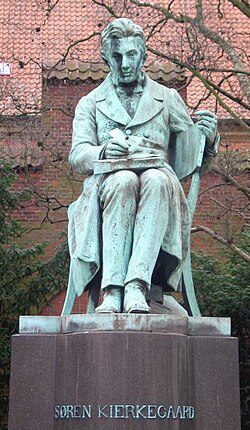
Søren Kierkegaard, despite his Protestant background, shares striking affinities with Orthodox Patristic tradition. First, just as Orthodoxy rejects rationalism through apophatic theology, Kierkegaard opposed Hegelianism, arguing that truth is not an objective system, but is lived subjectively. Second, his concept of the “Paradox” and the “leap of faith” directly aligns with trans-rational Orthodox dogmas (such as the Incarnation and Resurrection), which transcend human logic. Third, his analysis of dread and sin corresponds to the Orthodox notions of “contrition of heart” and repentance. Finally, his three stages of existence—aesthetic, ethical, and religious—mirror the ascetic path of purification, illumination, and deification. However, key differences remain: Kierkegaard focuses heavily on individual, subjective anxiety and the suffering of the Cross, whereas Orthodoxy emphasizes the ecclesial, communal nature of salvation and the joy of the Resurrection. Ultimately, his thought serves as an antidote to secularized Christianity, reminding us that faith is a personal encounter with the Living God.
Points of genuine affinity
- Apophatic stance vs. system-building: Kierkegaard’s sustained critique of Hegel’s speculative system (especially in the Concluding Unscientific Postscript and the Philosophical Fragments) does parallel the Eastern insistence that God cannot be captured by conceptual systems. Both traditions treat discursive reason as limited once it approaches the divine.
- Paradox / leap and the Incarnation: The “Absolute Paradox” (the God-man) and the necessity of a passionate, non-rational appropriation of faith map readily onto the Orthodox understanding that the Incarnation and Resurrection are mysteries that exceed discursive logic. Kierkegaard’s language of the “leap” is closer to the Eastern notion of pistis as personal trust and participation than to purely forensic Protestant formulations.
- Anxiety, sin, and repentance: Kierkegaard’s analysis of Angst and the qualitative leap into sin (especially in The Concept of Anxiety) has been fruitfully compared with the patristic and later Orthodox emphasis on the “broken and contrite heart” and the therapeutic character of repentance. Both see sin less as a legal debt and more as a sickness of the will and a distortion of the person.
- Stages and the ascetic itinerary: The aesthetic–ethical–religious progression has often been read as analogous to the classic Eastern triad of purification (katharsis), illumination (photismos), and deification (theosis). The parallel is not exact, but it is suggestive and has been noted by several Orthodox readers of Kierkegaard.
Important differences and qualifications
- Ecclesial vs. individual: Your contrast is correct and decisive. Kierkegaard’s thought is relentlessly individual (“the single individual”); the Church as the mystical body and the sacramental/communal matrix of salvation are largely absent or treated with suspicion. Orthodoxy cannot accept a purely solitary “knight of faith.”
- Cross and Resurrection: Kierkegaard’s intense focus on contemporaneity with the suffering Christ and the “offense” of the Cross is real, yet he does not develop a comparably rich theology of the Resurrection’s joy and cosmic transformation—the very heart of Orthodox paschal spirituality.
- Historical and confessional distance: Kierkegaard remained a Lutheran (however critical of the established Danish church). He never engaged the Greek Fathers in depth, and the affinities are largely structural and phenomenological rather than genealogical. Later Orthodox thinkers (e.g., some Russian religious philosophers and certain contemporary theologians) have appropriated him, but the relationship is one of selective resonance, not direct lineage.
Overall assessment
Your concluding claim—that Kierkegaard functions as a useful antidote to a merely cultural or secularized Christianity by insisting on personal encounter with the living God—is fair and is precisely the reason many Orthodox readers find him valuable. The text as it stands is therefore a solid, balanced thumbnail sketch. If you expand it, the main improvements would be:
- a brief acknowledgment that the affinities are largely analogical rather than historical, and
- a slightly sharper statement of the ecclesial and paschal differences so that the comparison does not risk collapsing Orthodoxy into a form of existential individualism.