




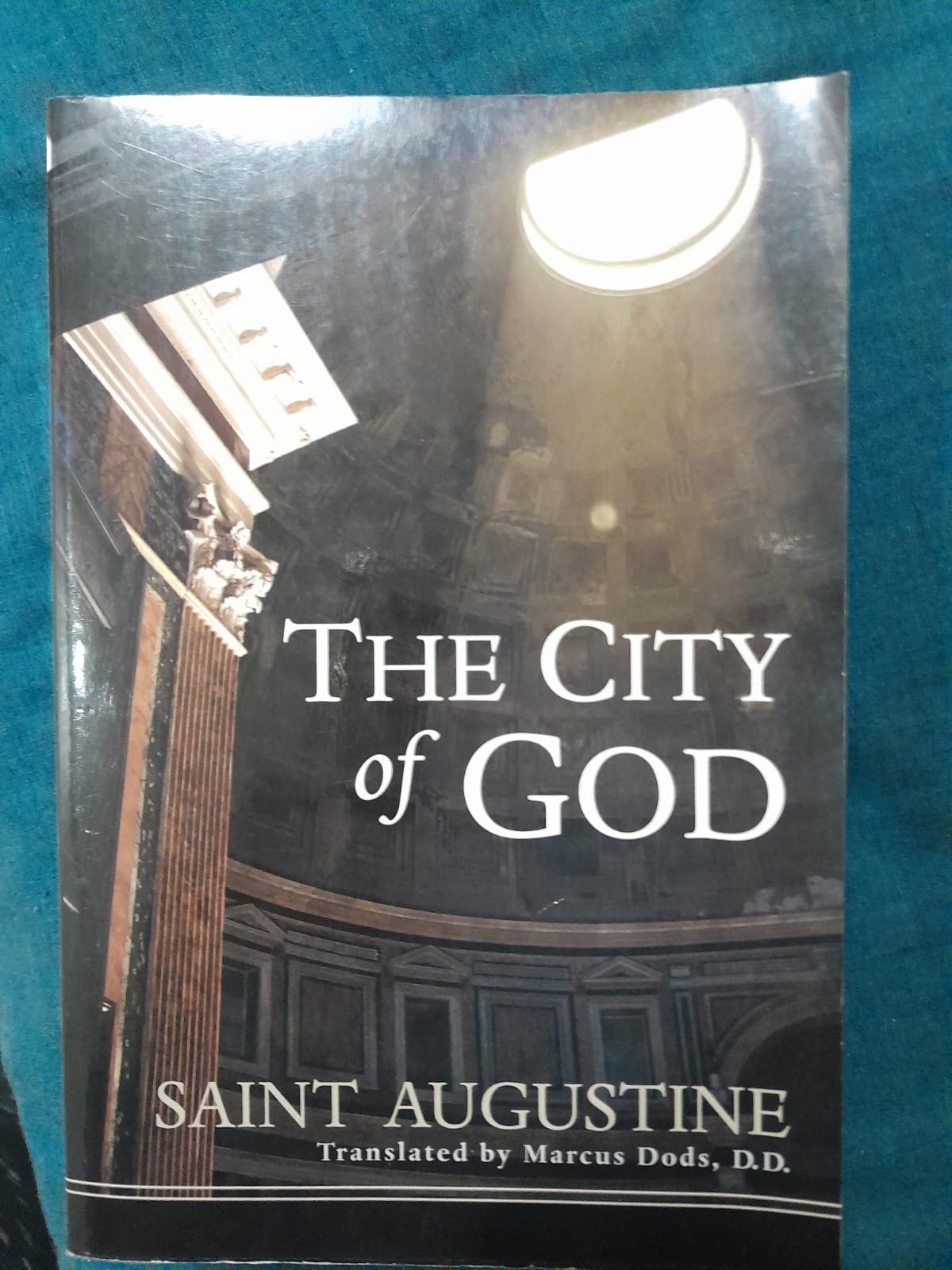
The City of God (De Civitate Dei contra Paganos, or Concerning the City of God Against the Pagans) is a monumental work of Christian theology, philosophy, and history by Saint Augustine of Hippo (354–430 AD). He wrote it between approximately 413 and 426 AD as a defense of Christianity and a profound reflection on human society, history, and destiny.
Historical Context
The work responds directly to the shocking sack of Rome by the Visigoths under Alaric in 410 AD. This event traumatized the Roman world, as Rome had symbolized order and invincibility for centuries. Many pagans blamed Christians, claiming that abandoning the traditional Roman gods (after Christianity became favored under emperors like Constantine) had provoked divine anger and caused Rome’s decline. Augustine, then bishop of Hippo in North Africa, wrote to refute these charges, console Christians, and offer a broader Christian interpretation of events. He argued that Rome’s fall stemmed from its own moral decay and internal vices, not Christianity, and that the old gods had never truly protected the city.
The book is massive—22 “books” (sections) in total—and was released in installments. It stands alongside Augustine’s Confessions as one of his most influential works and a cornerstone of Western thought.
Core Thesis: The Two Cities
Augustine’s central framework contrasts two symbolic “cities” or societies that have existed intertwined throughout history:
- The City of God (Heavenly City): Composed of those who love God above all else, even to the point of self-contempt. Its members live by faith as pilgrims (sojourners) on earth, oriented toward eternal peace, justice, and fellowship with God. It finds its ultimate fulfillment in the eternal kingdom after the Last Judgment.
- The City of Man (Earthly City or City of the World): Made up of those who love self above all, even to the contempt of God. It is driven by pride, lust for power, domination, and temporal goods. Earthly empires like Rome exemplify it, though they can achieve a relative “peace” through order and laws.
These cities arise from two loves:
“Accordingly, two cities have been formed by two loves: the earthly by the love of self, even to the contempt of God; the heavenly by the love of God, even to the contempt of self.” (Book XIV)
They are intermingled in this life (like wheat and tares in the parable) and cannot be perfectly distinguished until the end of time. Christians live as dual citizens—participating in earthly societies for the common good and earthly peace, while their true allegiance is to the City of God. History is the story of their conflict, ultimately resolved in God’s victory.
This is not primarily about church vs. state or a literal theocracy, but about fundamental orientations of the human heart: faith vs. unbelief, humility vs. pride, God-centered vs. self-centered living.
Structure
The work divides into two main parts:
- Books 1–10: Polemic against paganism.
- Books 1–5 refute the idea that pagan gods bring prosperity or protect empires in this life (citing Rome’s many disasters even when paganism dominated).
- Books 6–10 critique pagan philosophy and the notion that the gods secure happiness in the next life. Augustine engages deeply with Platonism (praising aspects of it while subordinating it to Christian revelation).
- Books 11–22: Positive exposition of the two cities.
- Books 11–14: Origins — Creation, the fall of angels, the fall of humanity (original sin), and how the two cities begin.
- Books 15–18: Progress/Development — Biblical history (Cain and Abel as archetypes; the line of Seth vs. the worldly line; parallel histories of Israel and earthly empires like Assyria and Rome).
- Books 19–22: Destined Ends — The nature of true peace and happiness (Book 19 is especially rich, discussing the summum bonum or highest good and critiquing philosophical definitions of it); the Last Judgment; resurrection; eternal life for the City of God; and eternal punishment for the City of Man.
Augustine presents human history as linear and providential—not cyclical as in much pagan thought—running from Creation to the Second Coming of Christ.
Key Themes
- Theodicy and Evil: Why do the righteous suffer? Augustine addresses the origin of evil (pride and the misuse of free will), original sin, and how God permits evil while bringing good from it. Suffering can refine the godly and punish or call the wicked to repentance.
- Justice and Kingdoms: A famous line: “Remove justice, then, what are kingdoms but great bands of robbers?” Earthly power without true justice is mere organized crime on a large scale.
- Peace: True peace is the “tranquility of order” found perfectly only in God. Earthly peace is a relative good that the City of God can use while on pilgrimage.
- Free Will and Grace: Human choice matters, yet all are born into the City of Man through Adam; rebirth into the City of God comes by God’s grace.
- Pilgrimage: Christians are aliens in this world, using its institutions without being defined by them.
Significance and Influence
The City of God is a Christian theology of history and a response to Plato’s Republic and Cicero’s works, reframing society around love of God rather than earthly ideals. It shaped medieval Christendom, influenced thinkers like Thomas Aquinas and John Calvin, and informed views on church-state relations, just war, and the limits of political power. Its vision of history as purposeful (moving toward divine judgment and redemption) contrasted with pagan fatalism or cyclical views.
Even today, it offers perspective on cultural decline, the interplay of faith and politics, the limits of earthly utopias, and finding hope amid chaos: earthly cities rise and fall, but the City of God endures.
Reading It Today
It’s long and discursive (over 1,000 pages in many editions), with detailed critiques of Roman myths that can feel dated, but the core ideas—especially the two cities, Book 14 on the two loves, and Book 19 on peace—remain powerful. Modern translations (e.g., by Henry Bettenson or Marcus Dods) make it more accessible. Full public-domain texts are available online (e.g., via New Advent or Project Gutenberg).
If you’re diving in, consider starting with summaries of the two-cities framework or focusing on key books (e.g., 11–14, 19). It’s a demanding but rewarding classic that rewards patient reading with a sweeping vision of reality centered on God.
What aspect interests you most—the historical background, the two cities concept, specific quotes