





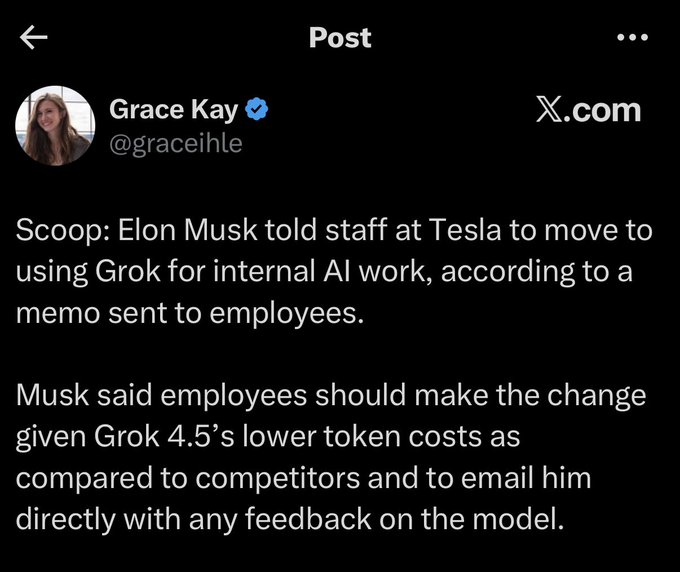
- Best-tool-for-the-job is the only sustainable strategy in AI deployment. Different models have different strengths (reasoning depth, coding style, domain knowledge, latency, cost, integration ease, safety properties, etc.). Forcing one model across the board risks suboptimal outcomes.
- Tesla and SpaceX operate in high-stakes environments: real-time autonomy (FSD, Optimus), manufacturing optimization, simulation, orbital mechanics, materials science, regulatory compliance, and massive-scale engineering. Any AI integration needs to demonstrably outperform alternatives on concrete metrics—accuracy, reliability, hallucination rate, inference speed on their hardware, explainability, etc.
- “Try it and keep what works” aligns with engineering culture. xAI’s goal is to build the most truth-seeking, capable systems; real-world validation beats press releases.
Nuances in enterprise AI adoption
- Evaluation cycles: Companies run side-by-side tests (A/B, shadow mode, benchmark suites tailored to internal workflows). A new model might excel at novel problem-solving or long-context reasoning but lag in specialized fine-tuning or ecosystem integration.
- Hybrid/multi-model reality: Many forward-leaning orgs already use mixtures—front-end routing, ensemble methods, or task-specific routing. Grok could handle creative ideation, scientific reasoning, or certain coding paradigms well, while others might dominate in vision, structured data, or legacy codebases.
- Data and integration hurdles: Internal datasets, security requirements, latency on vehicle/rocket hardware, and compliance (e.g., export controls for SpaceX) add layers. “Solving their task” means end-to-end value, not just impressive demos.
- Edge cases: Over-reliance on any single vendor creates supply risk. Rapid iteration in the AI field means today’s leader can be tomorrow’s also-ran—empirical testing is the antidote.
If Grok 4.5 (or future versions) delivers superior results on Tesla/SpaceX workloads—whether in reasoning about physics/optimization problems, code generation for complex systems, or multimodal understanding—that’s a win for capability advancement overall. If others stay ahead in certain niches, that’s fine too; competition drives progress.
Legacy media often prefers simple hero/villain stories over “we ran experiments and measured X% improvement on Y metric.” The truth is messier and more interesting: AI progress depends on relentless, unbiased measurement.