





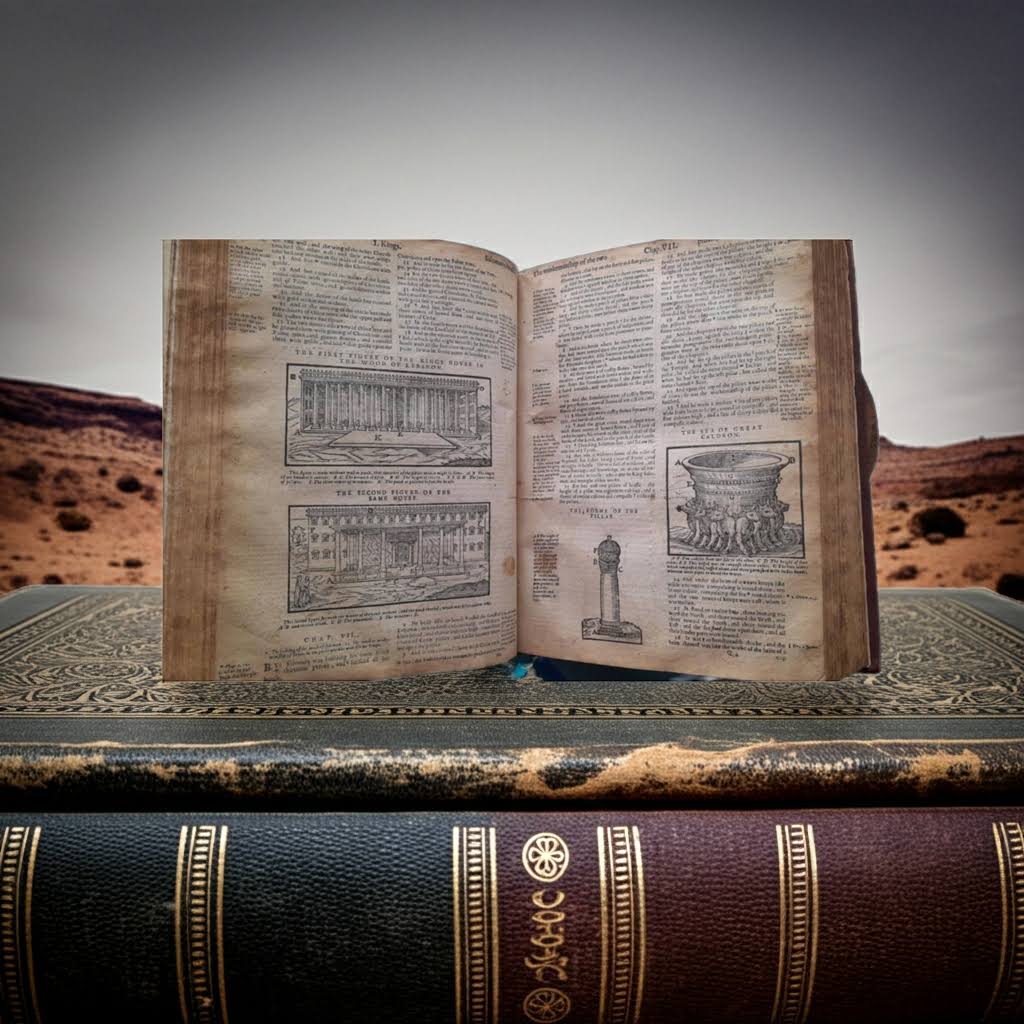
The Geneva Bible, often called the “Breeches Bible”, is a landmark English Protestant translation from the Reformation era. The nickname comes specifically from its rendering of Genesis 3:7:
“Then the eyes of them both were opened, and they knew that they were naked, and they sewed figge tree leaves together, and made themselves breeches.”
Most other early English versions (like the KJV) use “aprons” or similar terms for the coverings Adam and Eve made.
Historical Background
English Protestant scholars, exiled in Geneva during the reign of the Catholic Queen Mary I (“Bloody Mary,” 1553–1558), produced the translation. Key figures included William Whittingham (who led the New Testament in 1557), with assistance from Miles Coverdale, Anthony Gilby, Thomas Sampson, and others influenced by John Calvin and the broader Reformed tradition. The full Bible first appeared in 1560.
It was the first English Bible translated entirely from the original Hebrew and Greek texts (building on William Tyndale’s earlier work), the first to use numbered verses (making it easier to reference and study), and the first printed in Roman (rather than blackletter/Gothic) type for better readability. It quickly became the most popular English Bible of the 16th and early 17th centuries—used by Shakespeare, the Pilgrims who sailed on the Mayflower, and many Puritans. Over 140 editions were printed.
The 1599 edition is one of the most commonly referenced today. Many copies bearing a 1599 date on the title page (printed by Christopher Barker or his successors in London) were actually produced later—sometimes into the 1610s or 1620s—often with a fictitious date to navigate restrictions after King James I favored the new Authorized Version (KJV, 1611). Some later “1599” printings incorporated revisions, such as Laurence Tomson’s New Testament notes (from Theodore Beza) and Franciscus Junius’s notes on Revelation.
Key Features of the Geneva Bible (Including 1599 Editions)
- Extensive marginal notes: This made it history’s first true “study Bible.” The annotations were strongly Calvinist/Puritan in tone, offering theological explanations, cross-references, historical context, and sometimes pointed critiques of monarchy or Catholicism. King James I disliked these notes (calling some “seditious”) and preferred the KJV partly because it lacked such annotations initially.
- Study aids: Book introductions (“arguments”), chapter summaries, maps, woodcut illustrations, tables/indexes of names and topics, and metrical Psalms (often with music) in many copies.
- No Apocrypha in some later editions (or reduced).
- Influential on the KJV translators, who drew from it while producing their own version.
The 1599 edition is particularly valued by some modern readers for its notes, though scholars note that certain printings from this date can contain more typographical errors than earlier ones, and the notes grew more polemical over time.
Modern Availability
- Digital/online:
- BibleGateway hosts the 1599 Geneva Bible (GNV) for free reading.
- eBible.org, Monergism, and Archive.org offer full facsimiles or modernized-spelling versions (including PDFs of the “Patriot’s Edition”).
- TextusReceptusBibles.com has a 1560/1599 hybrid with original footnotes.
- Print editions: Modern reproductions include Tolle Lege Press’s readable reset version (not a strict facsimile, with updated typeface but original notes) and various large-print or facsimile reprints. Original 16th/17th-century copies are rare and collectible; some “1599” Breeches Bibles appear at auction or from rare book dealers.
The Geneva Bible played a major role in shaping Protestant thought, English literature, and early American religious culture before the KJV largely supplanted it in the Church of England. Its direct, vigorous language and study helps made Scripture more accessible to ordinary readers.
If you’re looking for a specific verse comparison, a digital link, details on differences from the KJV/1560 edition, or help locating a physical copy, let me know!