



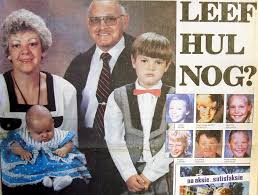
Gert van Rooyen, born Cornelius Gerhardus van Rooyen on 11 April 1938, was a South African builder, paedophile, and suspected serial killer who, with his partner Francina Johanna “Joey” Haarhoff, is believed to have abducted, sexually assaulted, and murdered at least six young girls (aged roughly 11–14) between 1988 and 1989.
His case remains one of South Africa’s most infamous unsolved mysteries because the victims’ bodies were never found, the pair died before trial, and persistent rumours of a larger paedophile ring or trafficking network have never been conclusively proven or disproven.
Background and Criminal History
Van Rooyen had a history of petty crime from a young age, including car theft (leading to reform school in the 1950s) and other thefts. He married, had six children, and ran a legitimate building construction business with his brothers.
In 1979, he abducted two girls (aged 10 and 13), took them to Hartbeespoort Dam, assaulted them sexually and physically, and released them the next day. He was convicted of abduction, sexual assault, and common assault, sentenced to four years (served three), and released in the early 1980s. He divorced his wife Aletta in 1983.
In 1988, he began a relationship with divorcee Joey Haarhoff (sometimes spelled Haarhof), who became his accomplice. She allegedly helped lure victims, sometimes by posing as someone trustworthy or contacting children’s homes. The couple reportedly applied (unsuccessfully) to foster children.
The Disappearances (The “Missing Six”)
Van Rooyen is strongly linked (via witness descriptions of vehicles like a white Ford Bantam pick-up with his business signage, a yellow VW Beetle, and items later found in his home) to these cases:
- 1 August 1988: Tracy-Lee Scott-Crossley (14), Randburg — Last seen getting into a yellow VW Beetle outside Cresta shopping mall.
- 22 December 1988: Fiona Harvey (12), Pietermaritzburg — Abducted while buying milk; witnesses linked a vehicle and man matching van Rooyen.
- 7 June 1989: Joan Horn (12), Pretoria.
- 22 September 1989: Odette Boucher (11) and Anne-Mari Wapenaar (12), Kempton Park — Disappeared while walking; letters (suspected written under duress) claiming they ran away were sent to parents. Personal items (e.g., Odette’s bag, Anne-Mari’s keys, addresses) were later found in van Rooyen’s home.
- 3 November 1989: Yolande Wessels (13), niece of Joey Haarhoff — Her prefect badge was reportedly found in van Rooyen’s possession.
Other possible links exist, such as 9-year-old Rosa Piel and cases in Durban/KwaZulu-Natal during holidays the couple spent there. Searches have included beaches near Umdloti, but no confirmed remains of his victims have been identified.
The Escape and Deaths (January 1990)
On 11 January 1990, 16-year-old Joan Booysen (small in stature, so possibly mistaken for younger) was lured by Haarhoff in Church Square, Pretoria. She was taken to van Rooyen’s house at 227 Malherbe Street, Capital Park (later called the “House of Horrors”), handcuffed, drugged, sexually assaulted, and locked in a cupboard.
Booysen escaped, alerted her family and police, and provided crucial testimony. Police surveilled the house. A few days later, when van Rooyen drove past in his white pick-up (matching an abduction vehicle), a chase ensued. Cornered, van Rooyen shot Haarhoff in the head with a .22 revolver, then killed himself with a .357 revolver on or around 15 January 1990.
They were never tried or convicted. Extensive searches of the home (demolished in 1996 for further investigation), business premises, and other sites (including possible burial spots) yielded no bodies, though incriminating items linked to victims were recovered.
Aftermath and Lingering Questions
- Van Rooyen’s sons faced their own legal issues later (one for perjury related to the case, others for other crimes).
- The house was donated to police for investigation; forensic efforts (sonar, sifting soil, etc.) found only non-human bones.
- Theories persist about a larger network, trafficking to other countries, or involvement of powerful people, fueled by the lack of bodies and incomplete investigations. Some survivors and witnesses have come forward over the years.
- Memorials and ongoing private investigations (e.g., by groups and individuals) seek closure for the families.
The case highlights failures in the justice system of the era and continues to haunt South Africa due to the missing children and unresolved questions. It is a grim chapter in the country’s true crime history.