




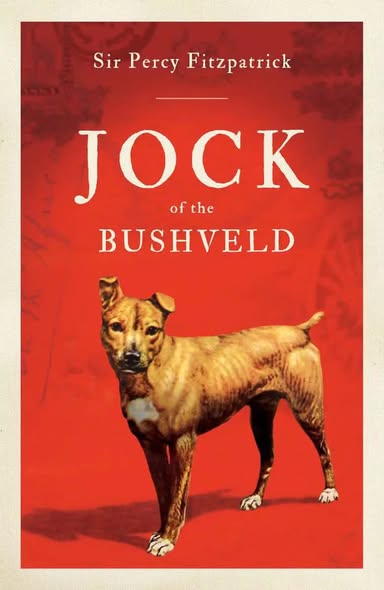
Jock of the Bushveld, first published in 1907 by Sir James Percy FitzPatrick, is an enduring piece of South African literature that provides an accurate account of life in the Bushveld region of the Transvaal during the 1880s.
Based closely on the author’s personal journals and the oral stories he later recounted to his children, the book functions as a valuable historical record of the realities of late 19th century South Africa.
The story takes place during a critical transitional period in the South African Republic. The dawn of the Transvaal gold rush was beginning to fundamentally alter the region’s demographics and economy, drawing thousands of prospectors and traders to the frontier. Prior to the expansion of railway networks, commercial logistics in the interior depended entirely on ox-wagon transport. FitzPatrick worked directly within this vital industry as a transport rider, a physically demanding role responsible for hauling heavy cargo across vast, undeveloped distances. His additional employment as a storeman, prospector’s assistant, and journalist provided him with a practical understanding of frontier society.
The core of the story focuses on FitzPatrick’s dog, Jock, a Staffordshire Bull Terrier cross. Jock’s mother, Jess, was a brindled bull terrier noted for her aggressive temperament but highly valued for her utility in a frontier camp. Jock was born the runt of a litter of six puppies. He lacked the solid yellow coat of his stronger siblings, displaying instead a pale, mixed coat with faint dark lines and a dark muzzle. Because the small pup was passed over by other drivers in the camp, FitzPatrick chose to adopt him.
The relationship between man and dog developed through the daily challenges of transport riding. The Bushveld terrain was geographically isolated and highly hazardous.
FitzPatrick eventually transitioned away from transport riding to establish a successful career as a businessman and politician, but his memoir achieved independent, long term success. Jock of the Bushveld became a standard reader in South African schools, introducing generations of students to colonial-era history.
Over the past century, the book has been translated into several languages and adapted into multiple theatrical and film production